Featured

A Study of the Solar Eclipse — Prize Edit

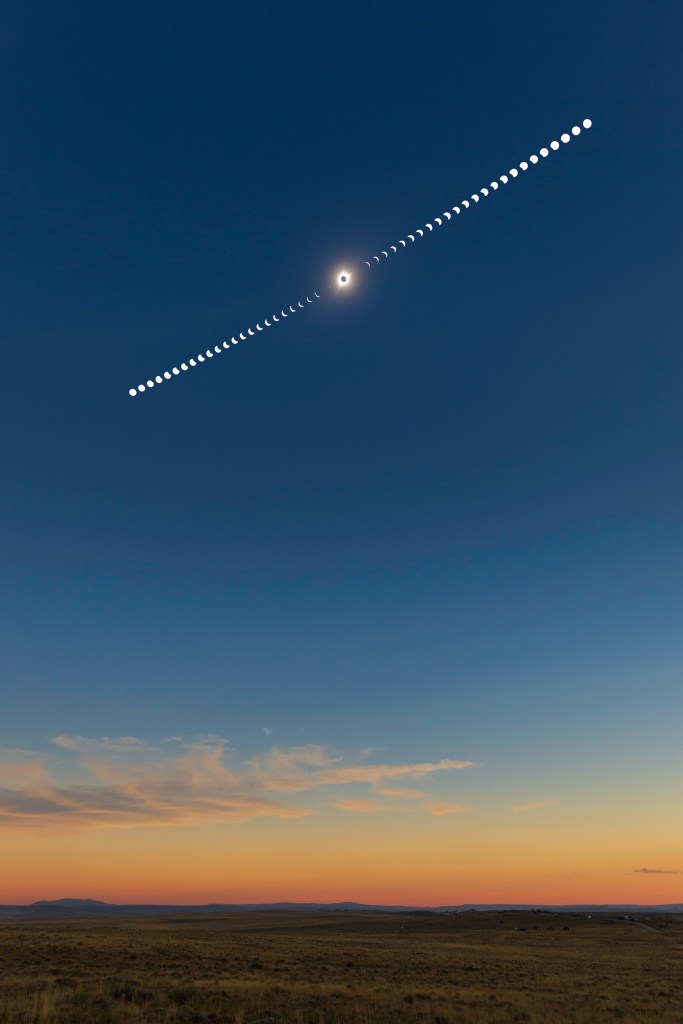
An enhanced version of the original eclipse progression photo my dad took.

A year ago I kicked off this blog with the post A Study of the Solar Eclipse. I later revised this piece and submitted it to a writing contest at my college, the University of Wisconsin-Madison. I won the second-place prize for the piece–you can find the contest results here. Below I’ve posted the prize-winning version. Enjoy!


The “Great American Eclipse” was an event unlike any other in American history. Crossing the continental states on August 21, 2017, over the course of a few hours the moon’s hulking shadow bisected the country on a path from Oregon to South Carolina. This solar eclipse, striking a well-populated and technologically connected continent, easily became the most viewed one in human history. My dad and I were among these millions of witnesses, and here I’ll try to put into words an astronomical event which words cannot fully describe. 

Our viewing location was, plainly, the middle of nowhere. The wind-battered high plains of Lysite, in central Wyoming, are a barren landscape, accessible only by long stretches of gravel road. They fall under the purview of the Bureau of Land Management, which organizes federal land not associated with a park, monument, or recreation area–essentially, the “leftovers” of public land. Yet there were few other places my dad and I would rather have been for the eclipse. Of locations where the moon would completely cover the sun, it had on average among the clearest skies, and was away from bustling areas such as Grand Teton National Park, over which the moon’s shadow was also to pass. Despite the remoteness, RVs, trailers, and trucks lined up alongside the primitive roads as far as we could see, most spaced out by a hundred yards or so. My dad and I joked that more human feces had been left on those plains in the last few days than in the entire previous history of human activity there. 

The appointed Monday began ordinarily, with some high, thin clouds, and the sun appearing as normal as ever. On the ground, however, the atmosphere was full of tension and excitement. People assembled lawn chairs, temporary shelters, telescopes, cameras, and binoculars near their vehicles. Our setup consisted of my dad’s Canon 6D camera and two pairs of binoculars covered in solar filter film, which blocks out over 99% of incoming light, dimming the sun to a level safe to observe. While the Canon snapped a time lapse of the eclipse from start to finish, we planned to use the binoculars to observe the progression of the moon’s disk across the sun. 

At 10:20 AM Mountain Time, our natural satellite began its slow crawl across the face of our star. Through the solar filters, the uncovered sun appeared as a monochrome white disk, with occasional black sunspots dotting its face as freckle-like splotches. Soon, another black form appeared, uncannier than any sunspot. Because the sun is so much brighter than the moon, the latter vanishes when viewed through a solar filter. Thus, observation of this partial eclipse phase is not so much watching the moon slide in front of the sun, but instead seeing the sun have progressively larger, circular bites taken out of it. First a small dent, then a longer arc, then a large semicircular chunk of star is lost to the darkness. 

It’s important to note that an eclipse is not some quick hit-and-run between two celestial objects. There was an eighty-minute difference between first contact and totality, when the sun is entirely obscured. To the naked eye, then, it doesn’t seem as if much is happening during most of the first partial phase: ambient lighting does change, but too slowly for our eyes to notice. This is what made our solar-filter binoculars so essential in seeing the whole eclipse. 

Still, late into the partial eclipse, we began to notice subtle but disquieting changes in the environment around us. The sun itself was still quite bright, but the distribution of light coming from it seemed off, as if it indeed was morphing into a different shape. Our shadows lost form and distinction, and eventually disappeared completely. Minutes before the start of totality, a cold breeze picked up, giving us both physical and psychological chills; the temperature had plunged noticeably since the first contact between sun and moon. It seemed as if an ominous, relentless force was approaching, and we were right in the middle of its path.

Seconds before totality, the most shocking sight yet appeared: miles west of us the moon’s shadow was surging towards us, gobbling up the distant mountains and plains without hesitation. This is when we and our neighboring eclipse-viewers started to make noise, composed of exclamatory shouts and cries of “Look!”–not so much to let others know what was happening, but more to convince ourselves that what we saw was actually real. One might expect some earth-shattering rumble to accompany the coming darkness, but there was none–the shadow raced silently along until its edge was too close to discern. Then, finally, it was upon us, and sky and earth were plunged into twilight darkness. Gone was our familiar parent star, and in its place loomed a circular rupture, as if opening to a foreign dimension, crowned by a fierce halo of broken sunbeams. 

Sol and Luna, day and night, fire and ice, light and darkness–total and irrevocable opposites to ancient and modern peoples alike–had merged into one utterly alien, majestic, and terrifying entity. No amount of studying star charts, time tables, and viewing locations could have prepared me to behold the astonishing astronomical fusion then before my eyes. Upon reflection, I was reminded of a unique battle between the ancient kingdoms of the Medes and the Lydians. The Greek historian Herodotus describes how, during the battle, “day was on a sudden changed to night.” A popular, but perhaps legendary, interpretation is that this event was the solar eclipse of 585 BC, supposedly predicted by the philosopher Thales. Whatever the reality, the two warring parties were spooked enough to immediately cease fighting and sign a peace treaty. Moderns might chuckle at the irrational superstition of Iron Age peoples. But after seeing the eclipse for myself, and experiencing that indescribable awe and terror, it’s plain to me that we are far more like our ancient ancestors than we may care to admit.

Witnessing the sun’s snuffing-out shocked my dad and I into a sort of frantic trance. Totality would only last for 2 minutes and 20 seconds, and we were keen on observing a few predetermined targets and relishing the miracle of syzygy. Now that it was safe to pop off the solar filters from our binoculars, we gazed at the corona, the upper atmosphere of the sun, which is visible only during an eclipse. It is twisted into intricate patterns by the sun’s magnetic field, and looks similar to how a bar magnet shapes nearby iron filings, except the corona paints its patterns with stunning streams of light instead of flecks of metal. On the limb of the sun, we watched the gaseous filaments of the chromosphere–a layer of the sun’s atmosphere below the corona–blaze with tempestuous energy, like a bonfire consuming twigs on a dry evening. 

The obscured sun was the star of the show, but the whole firmament had changed dramatically. Under the moon’s shadow, the sky appeared similar to mid-twilight conditions, and revealed the bright planets and stars as quickly as the sun’s light had disappeared. Mercury was now visible near the limb of the sun as a starlike point, and Jupiter and Saturn also made prominent showings. Normally invisible during August, the winter constellations–Orion, Canis Major, Taurus, and others–spanned the sky. Undoubtedly the most breathtaking feature was the sunset colors that lit up all 360 degrees of the horizon. Think of the most vibrant sunset you’ve seen, and imagine it stretching around the entire sky in every direction you look, like a giant halo of warm radiance surrounding you for tens of miles around. The combined spectacle of the blackened sun, daytime stars, and omnidirectional sunset is seared into my memory, yet was so exotic that I still have difficulty believing what I saw.

However long we might have wanted to watch, the celestial procession remained indifferent to our gawking stares, and was rapidly bringing about the end of totality. But it gave us one last flourish: just as the sun and moon began to split, we witnessed a brilliant flash known as the “diamond ring”. The irregular terrain on the moon meant that the sun’s disk did not re-emerge smoothly; instead, while most of the sun’s edge was still blocked by lunar mountains, some sunlight suddenly streamed through a valley, causing the flash. At this point the corona still visibly encircled the silhouetted moon, leading to the appearance of a ring of light set with a massive, dazzling diamond. The phenomenon lasted for a fleeting moment, before the sun became too bright to look at safely any longer. Then, as we brought our eyes away from the binoculars, the sky washed out with sunlight, and the sublime solunar union was finished. 

We and our fellow eclipse-watchers burst into applause and cheers to acclaim the greatest show any of us had seen. From that time onwards, the eclipse continued in the same manner as it did before totality, except reversed; the moon’s disk slowly slid away from the sun’s, and our star regained its familiar shape. In about an hour the sky returned to a sunny, humdrum state, as if nothing strange ever happened that morning. 

That two-and-a-half-minute period of totality was the culminating event in a much longer journey for me through astronomy and a fascination with the universe. Ever since I became interested in astronomy as a child, I’d been anticipating that eclipse by reading countless books and magazines. Somehow that passion was contagious, and my dad came to share it with me. Even with all the anticipation, it was more magnificent and awe-inspiring than either of us could have imagined. It remains one of my fondest memories, perhaps most of all because I got to share it with my dad. 

As a Christian, I believe this eclipse is God’s natural revelation speaking to us, and in this case louder than almost any other natural event. Indeed, my faith is bolstered whenever I reminisce about my experience. I am in awe of God’s power and majesty, that this sun which the ancients worshiped and which moderns so take for granted, which within its core fuses the equivalent of six hundred million hydrogen bombs every second, is like a toy in his hands. He spoke into existence its life-giving light, and he can snuff it out at any time without effort. It is humbling to see with our own eyes our lack of understanding and control over this universe we have been placed in, but radically comforting to know that our Father has complete knowledge and authority over it all. He set the sun, moon, and stars on their courses to display his glory and to reveal to us his character in ways too profound to be fully articulated. 

“He speaks to the sun and it does not shine;

he seals off the light of the stars.

He alone stretches out the heavens

and treads on the waves of the sea.

He is the Maker of the Bear and Orion,

the Pleiades and the constellations of the south.

He performs wonders that cannot be fathomed,

miracles that cannot be counted.”

–Job 9:7-10

On April 8, 2024, another solar eclipse will cross the United States. God will speak to the sun once again, and I intend to hear his voice. I hope you, too, will be listening.
Featured

Swimming and Confronting Chaos

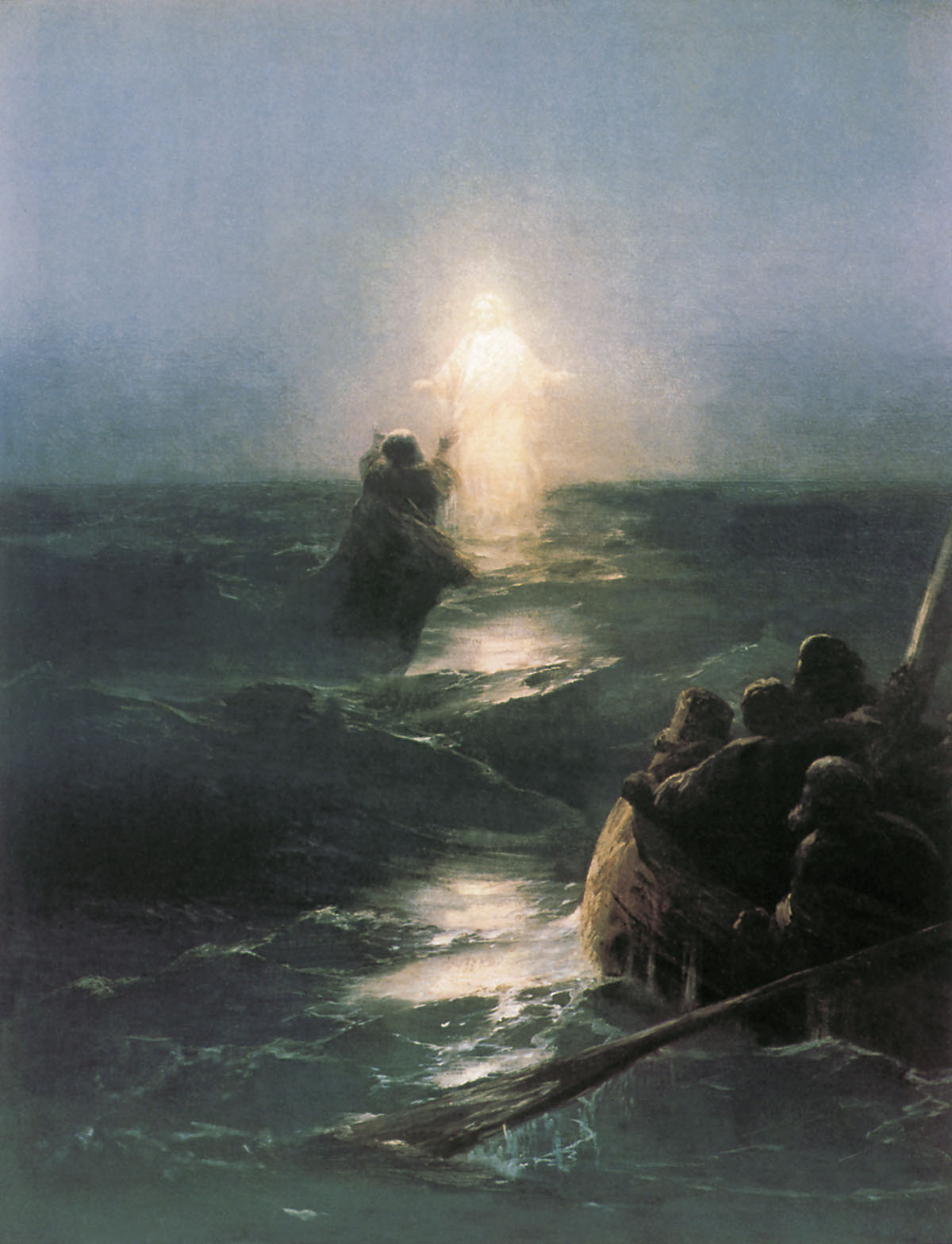
Image result for jesus walks on water

Ten years of my childhood and adolescence were spent participating in competitive swimming. It was by far my strongest extracurricular commitment, extending year-round in both club and high school programs. Through it I learned priceless life lessons and cultivated a habit of applying focused, determined effort to tasks. It also became a central part of my identity and value as a person, which, as anyone who has placed their self-worth in earthly pursuits can attest, was not such a good thing. There is a lot I wish to say in the future about my experience with swimming, but I want to start with a realization I came upon after first gaining some understanding about the deep symbolism present in the Genesis creation narrative and other areas of the Bible, and its thesis about the ontological nature of humanity.

Our God-given commission, according to Genesis, is to “Fill the earth and subdue it! Rule over the fish of the sea and the birds of the air and every creature that moves on the ground” (Gen 1:28 NET). In some respects we have done this thoroughly–think of how, for example, we have bred crops to be much more productive than they were in the wild–and in some respects we have gone too far, damaging parts of God’s creation instead of stewarding it. There is one element, however, which we have not really conquered, though we may think we have: water. We have navigated it, desalinated it, dammed it for power, watered countless crops with it, and purified and distributed it to millions of homes. But in facing it directly, in meeting water as it is in its essence, it dominates us. Instead of the elevated position and unfettered movement our bodies have on land, in water we find ourselves plunged into a viscous, hampering environment, with awkward locomotion and no solid surface on which to center ourselves. The head, where our consciousness is physically manifested and through which the God-given breath of Genesis 2:7 enters and animates our being, is mere inches from submersion it cannot long survive. Here already we are walking a figurative tightrope of order over the churning chaos in the pit below. Even in a public pool, where the water is entirely transparent, sanitized, and contained, we are still so close to the brink of possible death that we require specially trained individuals to supervise us constantly and guard our lives from being devoured into a watery grave. (That there are some 320,000 drowning deaths worldwide each year should give us additional sobering perspective.)

The creation story of Genesis 1 is one of separation. When God separated the waters and the land, he saw that it was good. He then created humans out of the dust of the separated, dry earth. Our natural environment, where we feel most secure, is the solid ground from which we emerged. In a symbolic sense, the reason that water is such a dangerous, alien environment to us is because in entering it we are undoing that original separation of land and sea. Plunging into the primordial depths, we get a sense of the uninhabitable state of creation prior to the divine Logos calling into existence the firm, terrene foundation we now take for granted. One way the Hebrew scriptures expressed this shadowy turmoil was in the form of Leviathan, the great sea monster which, while part of God’s creation, is immensely powerful and impervious to men’s efforts to either conquer or understand it (see Job 40-41). This mythopoetic illustration of water becomes literal reality in the New Testament when in Matthew 14 Jesus, the incarnate Logos, calls Peter to walk on the water of the raging Sea of Galilee. Peter’s temporary triumph over the chaos is contingent upon his faith in the Master of the sea, and when he becomes afraid and begins to succumb to it, only the Master can save him. After the resurrection–the apex of Christ confronting the ultimate chaos of death and emerging victorious–this reality is extended to every believer through water baptism, as the apostle Paul tells us: “We were therefore buried with him through baptism into death in order that, just as Christ was raised from the dead through the glory of the Father, we too may live a new life” (Rom. 6:4). That water is the representative medium through which the Christian ventures from death to life and from chaos to order in baptism truly solidifies the liquid’s high meta-symbolic status. More biblical examples abound, but I think from these water’s extensive role in the biblical canon is clear. 

When I understand swimming through this lens, I develop a much deeper respect for the sport itself and the experiences I underwent participating in it. All sports, particularly physically strenuous ones, are instances of death and rebirth, of confronting the chaos of potential and transforming and streamlining it into order. This happens in training, where kinesthetic energy is guided into technique through repetition, where mistakes can be made and corrected–it is a lengthy, grueling process to which athletes must give their full diligence to improve. I would argue that swimming, however, has unique dimensions of this archetypal reality that other sports do not. Terrestrial sports maintain our familiar senses: you feel the sweat dripping from your brow and the steady heave of your diaphragm; you see the ball, opponent, or finish line in front of you; you hear the shouts and cheers of teammates, coaches, and spectators. The chaos of underwater submersion sweeps away these senses and replaces them with dull, otherworldly ones. All you hear is the water rushing past your ears, which soon becomes background noise; you must abruptly lift your head out of the water to breathe at all; you can’t even tell how much you are sweating; and watching the black line on the bottom of the pool through fogged-up goggles offers few signs of progress towards a goal. By dismantling and re-colonizing the senses, swimming brings one’s consciousness deeper into the watery chaos, and therefore forces us to be properly ordered and grounded in order to succeed. 

Because swimming is low-impact on the joints, the limit to how much you can swim is theoretically governed by how long your muscles can function before giving out. This allows for practice periods that are a good deal longer than other sports. High school swimmers will go for two to three hours every day six days a week, and my high school team had brutal four-hour practices on certain days of the year. Collegiate athletes and Olympic swimmers, of course, train significantly longer than even that. For all that physical exertion, even more mental fortitude is required to survive and thrive in such circumstances. To conquer the element that is defined by flow, we must ourselves enter the “flow state”, in which we are untethered from mundane preoccupations and fully invested in the goal ahead of us on every level of our consciousness. It is a trancelike state, where we are entirely at one with the task at hand; it is rooted in what we already know and experience, but it must also push us far beyond the familiar, towards the highest threshold of our capacities. This is much like the way of living to which Christ calls his followers. Like he did with Peter, he beckons that each of us walks on the very edge between order and chaos, and with every step closer to him transform the personal chaos inside ourselves and the environmental chaos around us into order as he empowers us–this is the lifelong journey of Christian sanctification and theosis. 

There is one more facet of this aquatic sport that enables the straddling of the order-chaos dichotomy, and I believe it does so as clearly as it is possible for humans to perceive: open water swimming. This removes all artificial taming constraints and ordering mechanisms that we otherwise impose on water and meets it in its most primal state, the same state in which God first spoke it into existence. The comforts of clear water, still surfaces, and proximity to dry land have no place in the vast lakes and oceans in which this swimming takes place. Competing in a number of open water races has given me firsthand knowledge of how much closer open water swimming is to the archetypal chaos. Without the wide black line on the bottom and with the potential for wake across the water’s surface, swimming straight is a near-impossible task. Thus, a technique known as “sighting” is employed, where every several strokes the swimmer lifts his head forward to visually track a distant object in the direction he wants to go. In races this object is typically a large fluorescent-colored buoy. For open water swimmers enduring the travail of the miles-long open water race, this buoy–often a speck several hundred meters away throughout the race–is the sole, faint source of order and direction. I’ve found that distance swimming in general, due to its very repetitive nature, induces the flow state rather easily, but I have nowhere else plunged as deeply into the “zone” as I have with open water swimming. To put it abstractly, the reason for this seems to me to be a total removal of any frame of reference with which to compartmentalize and process the environment–that is, any notion of separation and categorization that became otherwise inherent to the universe as the seven days of creation progressed. Thus, the open water swimmer must revert to the only skill he possesses that will keep him alive, bring him to the finish, and carry him through the all-encompassing, unadulterated chaos in which he can be no more fully immersed. 

Some of these musings of mine might only resonate with the crazy few who, like myself, enjoy jumping into a cold, dark lake or ocean and swimming miles on end. Much of this writing has helped me process the integration of my experience in competitive swimming, and my emerging understanding of biblical chaos-order archetypes, across the temporal distance that separates them. I hope it has been a helpful and interesting look at how this chaos-order dynamic has played out in my life.

Miscellaneous Writings – 2021

Ursa Major lumbers across the Firehole River, Yellowstone National Park, WY.

Here are a few short, expressive pieces I wrote last year that don’t fit anywhere in particular. Hope you enjoy!


Prompt: “Compare and contrast the city/city life with nature/rural life”

That great concrete jungle beckons the ambitious masses, but there is no true wilderness, no true adventure within its limits. It echoes with the neutered roars of steel tigers and aluminum raptors, full of energy yet devoid of spirit. Those who enter it aspire to an Indiana Jones of industry, intent on snatching the golden idol of finance, technology, or politics before their rivals. But the plot of this Darwinist screenplay leaves few Jones and many hapless, dejected grunts in its wake. These grunts soldier on, through smog, snaking asphalt, and soaring rent, but their feet tire and their machetes dull. Strangled by the vines of mediocrity, struck by the poison darts of loneliness, they must fall back to friendlier climes or succumb to the disease of despair.

What bounties there are for those who escape! Those who dance with the doe in green pastures, who lie content with their beloved besides still waters–their home is the never-ending country. Not the tallest skyscraper of Babel soars to the heights of the humblest foothills, not the highest gilded penthouse equals the vantage atop the craggy mountain peaks. Who can strive amidst the calm rhythms of the sparrow, the squirrel and the salmon? Who can numb a day’s labor with the bottomless bottle while the setting sun ignites clouds to burn orange, scarlet, and indigo? Who can hunch over a black mirror into the morning hours while the fire crackles and the family sings under the starry host of heaven?


Prompts: “I just sat there as it melted” + “One year anniversary of Quarantine” (written March 2021)

One year ago, I sat by my window as the snow melted. 

It was March in the Midwest, the month where the grip of Jack Frost weakens, and the good earth springs to life again. How could I have known that even as this winter melted away, a much longer, colder, darker Winter was upon us in full force? 

Normally I would not spend all day next to my window, cooped up inside. I’d be on my university campus, enjoying my final semesters with friends, anticipating a future filled with possibility. But these are extraordinary times. It was as if we traded a vibrant, Incarnational world for a sick, Gnostic one, where professors, colleagues, and friends became false beings of light, confined to cold displays and grainy audio, masquerading behind fuzzy cameras and faceless names. Perhaps we once had a choice between the red pill and the blue pill. But callous nature and greedy governments forced the latter down our throats, and we plunged deep into electronic simulation and manipulation, questioning sanity and reality. The former life was a dream; this life, a nightmare entirely contained in cold chips of silicon. 

How many times have I craved that we tear off the twin masks of sanitary safety and social suspicion, and see the God-given glory of humanity in the faces of our fellow image-bearers? How many times have I lamented the loss of life, learning, and livelihood, praying that this disaster would subside? How many times have I asked, “How long, O Lord”? 

Today, I sit by my window as the snow melts. 

Where then is my hope which holds fast under the harshest pressure? It lies in my faith that this Winter does not have the last say. That the communion of saints on earth and in heaven never cease their praise and petition. That as surely as the sun rises, I know the Son has Risen, and He has prepared a place for a redeemed humanity. 

And one day I will gladly sit there as a single year of desolation just melts in the face of the eternity of the Age to Come.


Prompt: “An idea that has you”

Dead people stay dead
Common sense, right?
But this idea has me, instead:
There was one who conquered the night. 

He healed the sick, forgave sins, proclaimed:
“The Kingdom of God is at hand!”
For it he was betrayed, accused, and maimed
“Crucify him!” was his own people’s demand.

Crowned “King” on a cross
The pitiful death of a slave
His body wrapped by mourners of the loss
Laid in a rock-hewn grave.

But three days later, those wrappings stirred
His buried body drew breath again
Up rose the Messiah, the Son of God, the Word
Death trampled, and Victory won–Amen!

This idea the world hears from His Bride
From the poorest peasant to the richest king:
That if in Him we trust and abide
We too will live anew, His praises forever to sing.

An idea that has me secure
More real than any philosophy of man
A faith giving confidence to endure:
The Resurrection of the Son of Man.


That Great Old Bear

That great old bear
Tucked just below the waterfall
Salmon shimmering around his legs.

Many summers has he spent in the river
The long sun of Alaska
Guides his keen eyes.
Consistent, patient, steady as he lumbers
The spirit of Ursa Major, enfleshed.

A swarm of scarlet-red Sockeye
The still grizzly, a sudden lunge, and
Snap!
His catch wriggles fiercely
But the bear holds firm
Making a messy, gruesome meal
Out of a prized angling. 

Yet ravenous, he rinses and repeats
How can he eat so many? 
It’s worth it to skip the endless night
Winter, soon to come.
For now, he feasts,
This river is his buffet.

He does his viewers a service
In this Second Summer of Covid.
Relaxation, distraction, fascination with
That great old bear.

The Wind of the Winds

Myriad places of natural beauty in the world seem to have a “presence” or “spirit” about them. One notices this spirit by being present and paying attention to the environment. At the same time, its ways seem elusive, and even transient. “The wind—the spirit—blows where it wills, but you do not know where it comes from and where it goes.”

America’s West is brimming with these places and their accompanying spirit. On the northern end of Wyoming’s Wind River Range, the Green River, a tributary of the mighty Colorado, spends its infancy in a verdant valley cradle lined with soaring, jagged peaks. It is reminiscent of the much more popular Yosemite Valley, but the spirit of the Green River Lakes area is undisturbed by hordes of California tourists. That isolation made it an ideal spot for my dad and I to visit on one of our many outdoor adventures. 

A rutted gravel road leads away from civilization to a campground on the lower Green River Lake, a turquoise-blue portal on the course of the eponymous river. The overcast, drizzly August day casts subdued light across the landscape. I first notice the spirit while hiking the old-growth alpine woodland on the valley’s steep western bank. Coniferous sentinels exercise a sleepless watch, made sterner by the heavy moisture in the air. Moss claws at the woody ruins of fallen forest battlements. The birds are silent, and the endless, overlapping layers of gray trunks might hide a lurking beast mere meters away. One’s imagination drifts to Tolkein’s enchanted forests, shifting and swaying and whispering ancient tongues in the darkness. 

What a contrast, then, that the trees open to an inviting sandy beach at the upper end of the lake. At eight thousand feet of elevation, though, it’s not ideal for a summer swim. Beyond the far side a tributary gorge climbs eastwards. The low clouds wreath its ragged granite crown in mists of mystery. In a premonition of things to come, the vaporous spirit grasps and weaves among the mountains; sometimes breaking and revealing, quickly congealing and concealing. Further south the river winds through a marshy meadow, laden with thirsty plants and scampering critters.

We continue along the river towards the upper Green River Lake, a dark tongue in the mouth of the narrowing gorge. Looming over it is Squaretop Mountain, a massive stump of stone with thousands of feet of sheer sides. Firs and pines colonize its roots down to the valley floor. Nearer pinnacles form the eastern and western walls, their invisible summits piercing the gray sea above. One can hardly imagine the grating gnaw of glaciers carving and filling this tranquil place as they once did ages ago. They have sculpted scenery on par with bustling national parks, but here the vista is ours alone.

We watch the carpet of clouds closely. Like so many others who are drawn to the beauty of the American West, we’ve been captivated by the work of Ansel Adams, the undisputed master of landscape photography. His compositions painstakingly capture the spirit of a landscape as it varies in lighting, mood, and drama. While never pretending to match his skill, we have a chance to follow in his footsteps by capturing the scene unfolding above. Here on the wild lakeshore, we sense the wind of the Winds is restless. We do not know where it comes from or where it goes, but the camera shutter is at the ready—a sort of “lamp trimmed and burning”, waiting eagerly for the feast to begin.

The blanket above begins to fragment: rock walls emerge like spring flowers from a melting snowpack, while contrast develops between lighter and heavier cloud banks. Billows and tendrils of vapor dance across mountain faces; gray phantoms haunt high canyons. The only response is a steady click click click as my dad works the shutter. The scene changes so rapidly, for the clouds are but the spirit’s exhalations, here for seconds and vanishing into infinity. Any given configuration of clouds, peaks, and light quickly blends into the next. It’s impossible to tell in the moment which arrangement will turn out the most spectacular, so the only option is to click away as much as possible, with slight changes in focal length and up-and-down panning. The result is a single freeze-frame of how the spirit blew that day, a slice in time of restless glory:

We aren’t alone for long in enjoying the splendor. The new arrival isn’t another person, but instead the spirit again, in a much more tangible form that is animated by its life. I am so transfixed on the show across the lake that I miss its hulking presence until it’s almost next to us on the shore. I whisper-shout to my dad, and he whirls around to face the creature. A ranger of the forest, striding over deadwood as surely as the clouds across the mountains, emerges into the open marsh grasses nearby: a bull moose. Click, click, click goes the shutter again–almost on its own by now–to capture this startling appearance. National park and forest staff constantly warn visitors to not approach wildlife within a certain distance, but not often does the animal itself approach so close, just a few meters away.

The moose ignores us as it advances to slurp the rippling water with its rolling tongue. Loath to be caught in the open by danger, it drinks its fill and saunters back to the woods without lingering. My dad and I are silent with both wariness and awe—we have never been so close to such a large wild animal, especially not when it freely approaches us. But the spirit of the forest has another surprise in store. A second bull moose, even bigger and closer than the last, suddenly slips like a shadow from the trees into the grass, and copies its companion in drinking from the lake. At this point our jaws are hitting the sandy shore–not just one, but two of the normally solitary bulls have practically strolled right up to us! More adrenaline-fueled photo-shooting and gawking follow as the second moose messily gulps its fill and returns to the forest. I’m led to imagine the astonishment of the first humans to come face-to-face with these creatures, before hunting and taming and the yoke of civilization broke the virgin wilds. Our confrontation must be no less striking than theirs, for the same spirit commands our attention.

Clouds continue to swirl around the peaks in dynamic procession, with more twists and turns than the most suspenseful thrillers. Meanwhile, both moose, still hovering on the edge of the forest, block our path back to the trail. They’re in no hurry to move off. Time wears on as we try to balance our attention between the two marvels. We are at once thrilled to meet these majestic creatures on their own terms, and anxious they might suddenly decide we pose a threat. They have already shot us suspicious stares for moving to find a better shooting angle. In this moment we are at their mercy. Slowly these kings of the conifers nibble on one plant after another until they again merge with the gloom of the forest, back to roam unheard and unseen.

To the south, the waves of the sky’s sea are beginning to recede into calm. Feeling less wary and much hungrier from hiking and adrenaline, we say goodbye to the fading drama of the misty mountains and return to camp. We can’t express even to each other how blown away we are by all that happened as we hike back. It’s impossible to rank-order my experiences in nature, but this gray August day in the Winds easily surpasses any other for sheer variety. When I slog away at school and work through beguiling black mirrors, or pine for summer days in the bleak Midwest midwinter, I recall this day filled with wonder, peace, and meaning.

The spirit of creation has moved vividly on my many outdoor adventures, like the Great American Solar Eclipse, or sunrise from one of the country’s highest summits. Yet at no other time and place has it manifested in so many forms. That Spirit saturated the dense forest; hovered over the deep-blue lakes; wound to and fro along the gentle river’s course; leapt up and down the bubbling creeks and cascading waterfalls; sculpted a coat of many clouds around resolute summits; and orchestrated a raw encounter between creatures made conscious by his breath. We do not know where he comes from, where he goes, how long he will linger, or what surprises he carries with him. But we heed his call, and in so doing participate in the purpose of creation and the life of God.

A “Maximally Personal” Understanding of the Incarnation

Icon of Christ the Pantocrator (detail) - 6th c. Mt. Sinai ...

What does it mean that God is “personal”? Roughly speaking, that he is “like us” in many ways. But for Jews and Christians, it is actually we who are like him: “So God created mankind in his own image, in the image of God he created them; male and female he created them” (Gen. 1:27). So whatever “personality” is, it is grounded in God; in this sense he is “more personal” than we are since he defined and gave us our “personhood”. The Bible’s description of God supports this insight: fully loving and caring for his creatures, grieved and angered when humans break the covenant he formed with them, seeking justice and mercy, granting wisdom to the righteous, et cetera. Whatever all these attributes comprise, they surely indicate a God who is fully “personal”. 

We can combine this idea with Anselm’s famous ontological argument for God’s existence, which goes like this: “God is that which nothing greater can be conceived”, or “God is the maximally great being”. This applies to all of God’s attributes: he is not merely powerful, he is all-powerful; he is not merely loving, he is all-loving. Thus, if God is personal, then he is “maximally” personal–whatever “personality” is, it’s defined by his nature. But as we see in the biblical witness, “personality” is not merely a proposition about God. It is participatory and dynamic; it forms the basis for a relational metaphysic. 

In accordance with his personhood, God has revealed himself to his creatures. What would be the ultimate revelation of a maximally personal God? Naturally, it would be a Person. Here a problem seems to arise. God is “personal”, but he is certainly not a “human”, a “divine image-bearer”, as we are. Humans are derivative of God and cut off from him after the Fall, and so there is an ontological gulf between these two “persons” (“Who is man that you are mindful of him?”). How might this gap be bridged, that we could enter into full personal relationality with God? It clearly can’t happen from our own efforts–Babel and the entire record of failure in the Hebrew Bible testify against that idea. The Christian answer is that God descends to humanity’s level in the Person of Christ. He does not give up his “personhood” in doing this, because humans also are persons. In short, the intuition is that if God is maximally personal and relational, he will ultimately reveal himself in a Person to whom we can fully relate.

So even though God is already “maximally personal”, via the Incarnation he gains something else: humanity. This insight carries others with it. Christians have pondered over Jesus’s persistent self-designation as “Son of Man”. The tricky title has prophetic overtones with the book of Daniel, but for our purpose it describes Jesus as a true flesh-and-blood human who is the ideal for what a human should be. Jesus shows us the true way to be human, even the true way to be a “person”. His example requires “maximal personality”–and thus full oneness with God–to be the full truth. Only God, being our creator, can reveal the true way to be human, and only a human can show us how it’s done. It is the difference between the old covenants, where God said, “Let me tell you how to love me, love each other, and follow my commands”; and what God now says through Christ, “Let me show you how to do it on your own level”. I, at least, can conceive of no more “personal” and “relational” way for God to reveal himself. Thus our variation on the ontological argument comes full circle.

There are other directions we might take with this “maximally personal” argument. As I mentioned earlier, the maximal personality of God undergirds a relational metaphysic, by which I mean that God’s and our existence is first defined not by “objects” (as the modernist worldview would have it), but by “relations”. It follows from maximal personality that God is fundamentally relational, simply because “persons” are necessarily defined by relations. No person is an island; every person must have some other person(s) to relate to. Think again of the “personal” attributes ascribed to God in the Bible, and try to imagine them working without the existence of other “persons”. The notion of “person” simply has no meaning without relationality. If God is truly and maximally relational, then he cannot be “unipersonal”; he must relate eternally with some other person(s). But these persons cannot be independent of God (again recall the ontological argument), so all of them must participate within God’s single nature. Enter the Trinity: God relating eternally “within himself” as three persons, Father, Son, and Holy Spirit. 

All this theorizing has little significance if it cannot be applied pastorally, or indeed “personally” in the common sense of the word. How does a personal understanding of the Incarnation assist our sanctification and theosis? The New Testament puts pen into practice far better than I can. In Christ we have an advocate before the Father; through him we partake fully in the divine nature; he empathizes with our weaknesses. In Christ we see that God understands through and through the human condition. I might dare to sum these teachings as follows: before Christ we could only relate to God vertically, but through Christ we relate to God horizontally. We have access to an entirely new realm of “relationality” via the Person of the Son. Through Christ, we now speak to God as a man and as a friend; we see character to emulate and sufferings to bear; we find hope and victory in the first among the resurrected. With this perspective we realize that the question “Do you have a personal relationship with Jesus?” is not merely evangelical kitsch. It strikes at our very purpose for existence, and we must ask it of ourselves daily. This is the essence of how we know God: in a Person.

Healing Chaos, Transcending Order

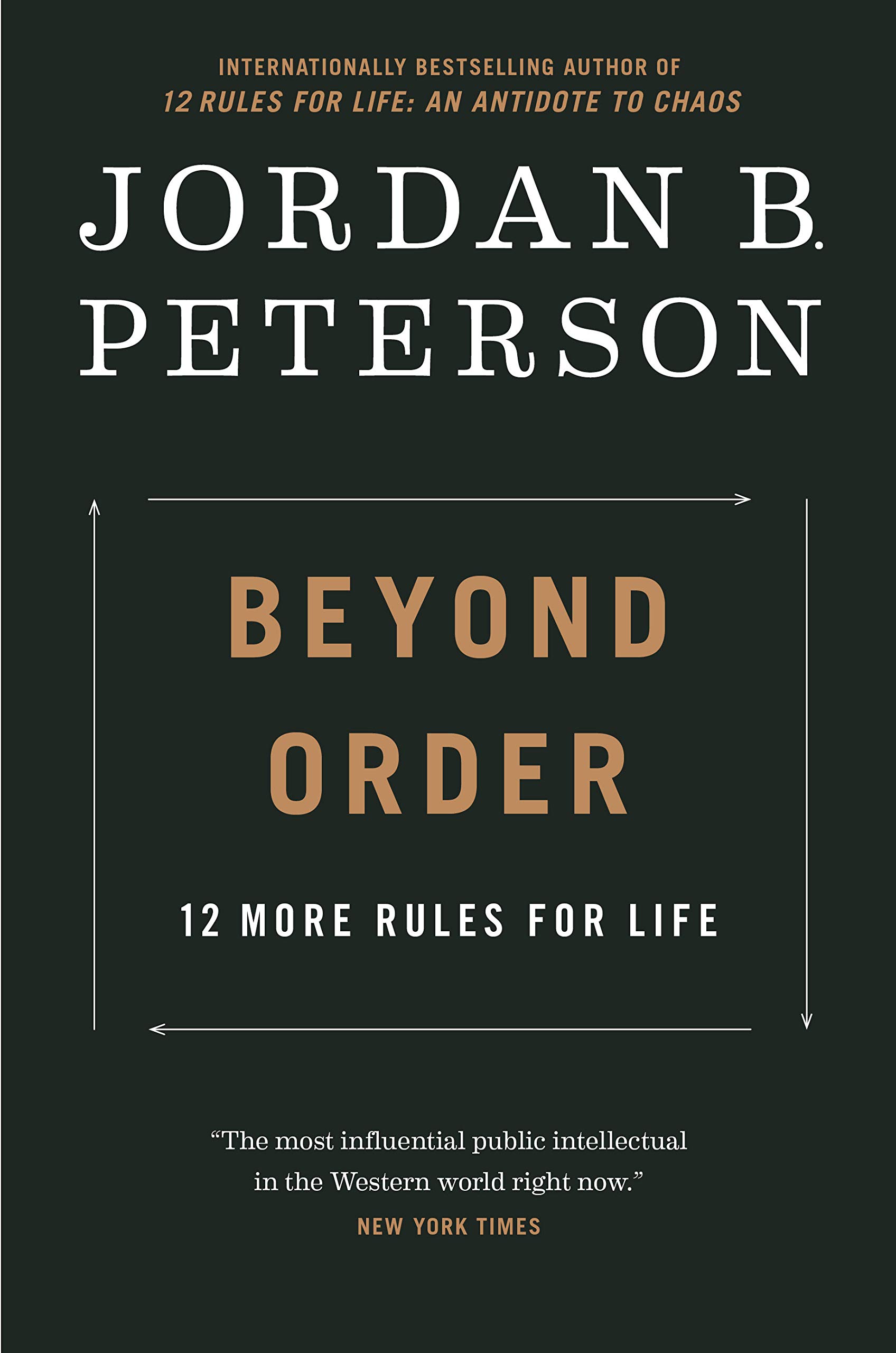
Beyond Order: 12 More Rules for Life: Peterson, Jordan B.: 9780593084649:  Amazon.com: Books

It’s an odd thing, perhaps, to eagerly anticipate a book of rules, given that the only rule in our atomizing cultural zeitgeist is that there should be no rules. But Beyond Order: 12 More Rules for Life is exactly the volume that I and many others have craved from the pen of psychologist Jordan Peterson. It is the sequel to the wildly successful 12 Rules for Life, which cemented Peterson as a sort of meaning-making guide for millions of people who felt the purpose in their lives being “dissolved in the acid bath of liquid modernity”, to use a phrase from theologian Carl Trueman. Peterson intends this new book to address the consequences of too much order, in contrast to the original, which aimed to be an “antidote to chaos”. Both books stand together, in Peterson’s own estimation, as the yin and yang of his effort to guide the lost on the narrow path of transcendent meaning. 

Beyond Order is laid out in the same way as the original 12 Rules. Each chapter is a standalone essay, where Peterson finesses personal anecdotes, psychological research, religious concepts, and symbolism to weave together a compelling case for transcending suffering and aiming towards the highest good. Most of the same themes dominant in the first book continue throughout this one. In fact, one or two chapters are explicit extensions of ideas Peterson has been promoting for years, such as trying to make one room in your house as beautiful as possible. Hierarchies, Piagetian social games, Ancient Near-Eastern mythology, and the roots and dangers of totalitarian and ideological impulses all feature prominently in the first half of the book. Herein lies a slight criticism: much of the book is repetition from the Peterson schtick that his audience has heard many times. Still, this book is by no means a washed-up sequel to a one-and-done franchise. By far the most change between the volumes is in the author himself. As is well known by those who follow Peterson closely, starting in 2019 he encountered a catastrophe of serious health problems, first with his wife and then with himself. There’s no reason to discuss the details here, but it suffices to say that he’s been to hell and back. He wrote Beyond Order under these incredibly strained conditions, which is a true testament to the man’s character and fortitude. Because of this, the book has a grittier and more serious feeling than does the first. It has the tone of a man who has come as close to a personal hell on earth as one can, and the way he conveys timeless ideas reflect the deeper understanding that such an experience would engender.

As a Christian, I’m particularly interested in the way Peterson expounds biblical texts and Christian ideas. Though not a confessional Christian, he has a strong aptitude for communicating the symbolic and archetypal roles that Christ plays, which is something that modern (especially evangelical) Christians often fail to recognize. One of his most salient insights in this regard is based off of passages like Mark 12:28-34 and Luke 5:17, which demonstrate that Christ is the “embodiment of the mastery of dogma and the (consequent) emergence of spirit” and “the product of tradition, and the very thing that creates and transforms it” (197). This is the sort of paradigm-shifting insight that no modern preacher or pastor is going to deliver. That said, it’s clear that Peterson is no biblical scholar. He never addresses, for example, the perceptions and intentions of the biblical authors in their cultural contexts, nor the distinctly Jewish Messianic office Jesus claims for himself, but always reaches straight for the transcultural and timeless elements of the text, usually within a framework of Jungian archetypes. Despite the significant blind spots his approach incurs, he nonetheless (perhaps subconsciously) paints Christ as a singularly compelling figure, the archetypal but concretely instantiated Man who transcended chaos and order, humanity and divinity. If the reader squints, perhaps he or she can see the beginning of a redemption of Petersonian (and by extension Jungian) thought, hinting at the subsuming and repurposing of this worldview within the kingdom of God.

The second half of the book is undoubtedly more interesting than the first. It’s chock full of both fascinating anecdotes and sagacious practical advice. By Rule 10, which deals with working diligently to maintain the romance in a relationship, Peterson has hit full stride. In one section he discusses the importance of specifying clearly one’s desires in the process of negotiation with one’s partner, and just a few paragraphs later he connects that to how Christ’s spiritual perfection as the new Adam emerges through the ideal balance between masculinity and femininity. It’s feats of communicative acrobatics like these which remind Peterson fans of why he has been so impactful in the modern effort to recover meaning. Rule 10 stands out for being a strongly practical chapter, and it’s my personal favorite.

Peterson is notably adept at addressing the perennial problems of resentment, deceit, and arrogance. In Rule 11, he lays out what he sees as the seven eternal characters of the human drama: the Dragon of Chaos, the Loving Mother and the Evil Queen (Nature), the Wise King and the Authoritarian Tyrant (Society), and the Hero and the Adversary (Individual). These characters serve as the base for one of the best arguments against that unholy trinity outside of Christianity itself. Writing like this demonstrates Peterson’s (archetypal) role as the Markan Unauthorized Exorcist (see Mk. 9:38-41), an idea first put forward by Christian Reformed Church minister Paul VanderKlay. By combating the demons of resentment, deceit, and arrogance, Peterson has called many people back from the brink of destruction, showing them instead that life has meaning through the bearing of responsibility. Though he does not perform these exorcisms under a particular faith claim or church authority, I am convinced that he has been central to great personal victories in spiritual warfare. Without overstating the case, I believe Peterson is helping to usher in the kingdom of God in his own idiosyncratic way, and Christians will do well to pay attention.

Peterson ends the book with his most personal essay yet, about being grateful in spite of your suffering. Given the events in his life over the past two years, few others have comparable standing to discuss this topic. He advocates against the Mephistophelian, adversarial spirit of doing what we should not and not doing what we should. He encourages us to be the most reliable person at the funeral of a loved one. He preaches that the act of gratefulness is a leap of faith; that it is to treat our loved ones better than before and insist that a deceased person’s existence was worthwhile. Upon finally closing the book, I was reminded of the scribe to whom Christ says, “You are not far from the kingdom of God”. Peterson is that scribe, inquiring of the divine, and recognizing Truth embodied in the universe. These two books of 12 rules each are as much the journey of one man as they are the maps of meaning-making for many. We all can pray that Peterson in the end finds what–Who–he seeks so earnestly.

If you want notes for the book, you can check out my outline here.

Shall We Become Ocean?

What is the ocean? What is the sound of the depths? Shall we “become” the ocean?

These are the questions John Luther Adams calls forth in his compelling orchestral piece, “Become Ocean”. The listener quickly realizes that the floodgates of melody and harmony have been breached, and water flows through them as it pleases–sometimes as a gentle current as naturally as air fills the lungs, and other times as a violent swell, a tsunami of sound which bursts forth and soon dissipates. Adams cites the sounds and sensations of nature as the primary inspiration for his work. In kind, I recall my many adventures in the great national parks and natural areas of my country, where nature indeed sings music of its own, in the brooks and the birds and the billowing winds and waves. It is this music which Adams has dedicated his career to recreate.

The thesis of human music is argued through the creative imposition of order upon a chaotic sea of sound, to tell great narratives and organize the human experience. Adams’ composition, in postmodern fashion, represents the antithesis, abandoning all musical structure–unwittingly, perhaps, recalling a time when “the earth was formless and void, and darkness was over the face of the deep…”. Indeed, the undoing of orderly creation is the watery void, where there is no distinction or separation. We do well to recognize Adams’ remarkable achievement in co-opting the Western orchestra, a pinnacle of creative structure and harmony, into the cry of an alien past, with the characteristic sound of each instrument dissolved into a sonic morass. 

In describing the experience of the listener, myriad aquatic metaphors present themselves. One is “swept up” and “carried away” by the music; one is “immersed” in a “sea of sound”, “unanchored” from normal awareness to enter a “flow state” wherein the music “washes over” the imagination. “Become Ocean” moves its listeners to utter wonder. It gives the listener gills, but not fins, casting us to and fro in the depths without the means to influence our course, enrapturing us in an aural abyss lacking rhyme or reason. The book of Genesis declares of humanity: “Dust you are, and to dust you shall return.” This piece reverberates with the murmurs of the dust that went before us, and will continue long after we have returned to it.

What shall we say, then, to Adams’ questions? 

Can we truly unmoor ourselves in the endless deep through music, apprehending its primal echoes in a time unshackled by order and discretization, a time before time itself? As much as Adams may succeed in evoking the sensation, the medium itself rebukes him. Without the slightest perturbation, the conductor’s wand moves back and forth, steady as a clock’s pendulum; just as chronological time reigns with predictable, periodic motion, so too must musical time. The conductor orders the players’ steps, though Adams would have you imagine there is nothing solid in his piece to walk on. No performer is without sheet music, neatly arrayed in a melodic prose that does not wander aimlessly, but proceeds without interruption to its inevitable terminus. The music must end; the ocean cannot, roiling and beating and swelling onwards into infinity.

Can we understand what the depths truly are? Without ultimate structure, Adams’ piece lacks the agent who speaks to the ocean its purpose, the One above all the chaos: “…and the Spirit of God moved upon the face of the waters”. The oceans do not exist, in the end, to crash about with primordial potential, as Adams might have us imagine in his piece that ebbs without resolution. The oceans exist to be separated, to be rent forth and in their rending reveal the glory of their Creator. In pulling back the seas and saying “No further”, this Creator makes way for the cosmic mountain atop which His image-bearers are to reside. Who but He can comprehend and order the chaos? Who but He can restrain Leviathan, the archetypal monster of the deep? The same questions once fielded to a stupefied Job will no more relent today to our modern frameworks of thought. 

Shall we “become” the ocean, in its endless, churning, chaos? We humans are creatures of separation: first from the darkness, then from the ocean, then from the plants, then from the lower animals, and lastly from the earth, when the breath of God gives Spirit to physical form. In separating the chaotic waters so far from humans, God sets them in utter contrast to our purpose of being mediators between heaven and earth. Genesis claims we are to be the high priests of the Edenic temple, to co-rule with God from the cosmic mountain. The rest of the Bible points toward the Messiah who fulfilled this calling where the rest of us could not. This Messiah, the God-Man, displayed supreme dominion over the great seas, striding across them where all others would drown and rebuking them to stillness where all others would be thrashed. Just as He called Peter out of the boat to conquer the watery chaos, so He does all of us, and promises ultimate victory if we trust Him. In this baptism of body and spirit, for a time we are buried under the waves, but we always emerge with resurrection life in hand. To “become” the ocean, then, is to refuse the teleology of our nature. To become the ocean is to reject our very being, and even to reject the Ground of being Himself. 

After all, there is no ground in the ocean.

Augustine’s Modern-Day Meaning Crisis

Readers of the Confessions know how surprisingly relevant this ancient masterpiece is to our modern age. In the process of interleaving his intellectual development with his personal confusion and consternation over his lifestyle and relationships, Augustine speaks to many facets of human experience. Far from being a dry patristic tract, Confessions paints a picture of a man who, even while defending his episcopal authority against contemporary opponents, integrates his high theology with a deep spiritual and devotional life to a degree few others have matched.

In recent decades, Augustine’s thought has received much attention from biblical scholars intent on addressing the Neoplatonic contaminations that have accrued in the Western Church’s hermeneutics, thanks to Augustine’s titanic influence. This is crucial work, but I leave any discussion to the side for this post. I’ve noticed the striking correspondence between Augustine’s journey in Confessions and the migration of many modern-day nihilists and atheists to a renewed faith in Christ, or at least a serious interest in the Bible. (Many of these journeys are documented on Christian Reformed Church minister Paul VanderKlay’s channel. One example in particular here.) Much of the credit for this trend belongs to the hugely popular psychologist Jordan Peterson, who with his lectures on Genesis and frequent use of religious ideas has helped dismantle the church of New Atheism, showing its bishop’s gospel toothless in the quest for transcendent meaning. 

Augustine experienced what we might call a “meaning crisis”, wherein both individuals and societies are unmoored and alienated from traditional meaning-making structures, such as religion, philosophy, and myths, and fail to see the purpose in existence. Accompanying this phenomenon is psychological agony and spiritual restlessness in the individual, and increasing decadence and loss of cultural identity in society. (See cognitive psychologist John Vervaeke’s lecture series for a deep dive into the meaning crisis). Our ongoing meaning crisis in the West is centuries in the making, and is obvious to anyone who has eyes to see: skyrocketing suicide rates, collapsing church attendance, and the replacement of traditional religion with political ideologies are just a few of the tragic symptoms. 

Augustine’s own meaning crisis is evident through his impassioned prose and heartfelt confessions to God. Raised in (but not yet baptized into) the Church in childhood by his devout mother, he does not remain in the faith as he moves into adulthood: 

“The single desire that dominated my search for delight was simply to love and be loved… I travelled very far from you, and you did not stop me. I was tossed about and split, scattered and boiled dry in my fornications.” (II. ii (2))

During a deconstruction process in which he joined Manicheanism, a gnostic religion rooted in the teachings of the Mesopotamian prophet Mani, he finds the Bible wanting: 

“[The scriptures] seemed to me unworthy in comparison with the dignity of Cicero. My inflated conceit shunned the Bible’s restraint, and my gaze never penetrated to its inwardness.” (III. v (9))

Many modern-day millennials (particularly those in America) who were raised in evangelical and fundamentalist churches later left Christianity as adults, finding these churches’ sterilized “literal” interpretation of the Bible uncompelling, and the religion itself backwards and intellectually bankrupt. They then join the ranks of the “nones”, under the banners of atheism, nihilism, New Age, or simply an atomized “spirituality”. Here and elsewhere Augustine puts forth similar developments in his own life. He finds the authority of the Bible and the Church unconvincing, and leaves them for another religious ideology that falsely postures itself as novel and intellectually rigorous. Of course Augustine was no adherent of atheism or New Age spirituality, but those modern ideologies are inextricably dependent on Christianity, as was Manicheanism to a large extent. 

Over the years of his teaching rhetoric at Carthage, Rome, and then Milan, Augustine’s enthusiasm for Manicheanism generates deep questions–questions that he finds the Manicheans unable to answer. He describes his encounter with an important Manichean leader:

“There had arrived at Carthage a Manichee bishop named Faustus, a great trap of the devil by which many were captured as a result of his smooth talk. Although I admired his soft eloquence, nevertheless I came to discern his doctrines to diverge from the truth of the matters about which I was keen to learn.” (V. iii (3))

“Nevertheless I put forward my problems for consideration and discussion. [Faustus] modestly did not even venture to take up the burden. He knew himself to be uninformed on these matters and was not ashamed to confess it.” (V. vii (12))

The eloquence and rhetorical prowess of the new atheists, and Christopher Hitchens in particular, were what convinced many critically-thinking “nones” to reject faith in the first place. But deep probing into matters of truth and meaning have shown the atheists totally ignorant of religion and the human apparatus for meaning making, as exemplified in one of Sam Harris’s dialogues with Peterson. The celebrity atheists believe they have some “objective” viewpoint above the fray of human “irrationality”–a modern sort of gnosis, or secret knowledge, similar to that which a high-status Manichean like Faustus would purport to possess. Yet on closer inspection it’s evident they’re swimming in the same epistemological and worldview waters as the rest of us. Augustine probes the highly reputed Faustus and quickly discovered the man unprepared for serious questions by a bright mind. “In consequence the enthusiasm I had for the writings of Mani was diminished” (V. vii (12)), but still “I had no hope that the truth could be found in your Church” (V. x (19)). 

It is at Milan that Augustine meets the bishop Ambrose, who plays an influential role in Augustine’s conversion. Thanks to the bishop’s preaching, Augustine begins to revise his understanding of the scriptures:

“Those texts which, taken literally, seemed to contain perverse teaching [Ambrose] would expound spiritually, removing the mystical veil.” (VI. v (6))

This part in Augustine’s journey is reminiscent of how Peterson’s analysis of the Bible in his Genesis series has proven far more compelling to the “nones” than any evangelical pastor using a “literal” interpretation. Unlike Ambrose, Peterson is not an orthodox Christian, but the parallels are still interesting: a person’s long-held, incorrect assumptions about the Bible are broken by a highly intelligent, educated expositor who shines a new light on the text. The result? “From this time on, however, I now gave my preference to the Catholic faith” (VI. v (7)). After hearing their respective expositors, Augustine and atheist alike are curious about Christianity again. 

Yet this process is never as easy as it seems. Like many of us moderns yearning for a deeper sense of meaning, but caught up in the perpetual distractions and confusions of the modern age, Augustine writes:

“I began to burn with a zeal for wisdom, planning that when I had found it I would abandon all the empty hopes and lying follies of hollow ambitions. And here I was already thirty, and still mucking about in the same mire in a state of indecision, avid to enjoy present fugitive delights which were dispersing my concentration…” (VI. xi (18))

Fewer lines in Augustine ring truer as a description of the symptoms of tireless modern society. What modern-day “none”, quickly entering the ages of marriage and child-rearing and now unmoored from the former certainty of rationalist materialism, would not experience such inner turmoil?

Augustine wasn’t yet ready to accept the Christian beliefs about Jesus, but instead holds opinions not far from those of a “none” who is at least growing more sympathetic to religion:

“I thought of Christ my Lord only as a man of excellent wisdom… I thought he excelled others not as the personal embodiment of the Truth, but because of the great excellence of his human character and more perfect participation in wisdom.” (VII. xix (25))

As with many of the intellectual, inquisitive “nones”, he is earnesty searching for meaning, as evidenced by this particularly profound quote:

“My desire was not to be more certain of you but to be more stable in you.” (VIII. i (1))

Many young men in the “nones” who lack a good father in their lives have considered Peterson a father figure. In the same way, Augustine develops two spiritual fathers in the wake of his pagan biological father’s death. Ambrose, already mentioned, stirs Augustine’s heart with the teachings of the Bible and eventually baptizes him. Simplicianus, successor to Ambrose as bishop of Milan, provided consolation and encouragement to Augustine. 

Augustine is well-known for his fusion of Christianity and Neoplatonism. In book VII, he describes his discovery of deep truth in the “books of the Platonists” (specifically those of Plotinus and Porphyry). This framework of Neoplatonism helped him develop unique theological insights into Christianity that have stuck with the Church for over 1500 years. This fusion has arguably imported a few significant errors into Western thought which we can’t discuss now, but Augustine’s genius and influence make his ideas certainly worthy of consideration. None of this development would have been possible without his personal meaning crisis and relentless search for truth. In a similar way, Peterson’s psychological approach to faith and the Bible is not without errors (one of his primary influences, Carl Jung, was not exactly a Christian thinker), but it has enabled many intellectual “nones” to understand Christianity with a fresh perspective.

Even upon being intellectually convinced of the faith, Augustine still struggles with a full acceptance of Christianity:

“By now I was indeed quite sure about [the truth]. Yet I was still bound down to the earth. I was refusing to become your soldier… I, convinced by that truth, had no answer to give you except merely slow and sleepy words: ‘At once’–’But presently’–’Just a little longer, please’.” (VIII. v (11)-(12))

Christianity is no mere ideology. It is not even merely a way of life. It is the Way of eternal life, of life beyond this present age into the Age to Come. It requires the crucifixion of our old selves to whom we are so attached, in favor of faith in things unseen by worldly eyes. What individual would not balk, whether he be a genius of antiquity or a “none” of modernity, when facing this realization? But finally, in the famous moment at the Milan garden, full of tears and anguish, Augustine hears the child’s voice: “Pick up and read”. He quickly finds Romans 13:13-14, and:

“At once, with the last words of this sentence, it was as if a light of relief from all anxiety flooded into my heart. All the shadows of doubt were dispelled.” (VIII. xii (29))

Augustine’s journey from meaning crisis to faith was a long, hard road. The gnarled highways of modernity on which we all now travel present much different, but no less difficult, obstacles to trusting in God. Yet we should take heart that Peterson, a present-day Markan unauthorized exorcist, has in his own way found a straight and narrow path, and even now leads the pilgrims of this bleak age towards a brighter future.


Source: Augustine of Hippo. Confessions. Translated by Henry Chadwick, Oxford University Press, 1991.

The Ruach Prayer

Last year I had the privilege of visiting one of America’s lesser-known national parks, Great Sand Dunes (on the same trip that I experienced sunrise in the San Juan Mountains). Nestled in a bay-like formation between Colorado’s soaring Sangre de Cristo Mountains to the east and the vast Rio Grande river valley to the west lies a complex of North America’s largest sand dunes, rising seven to eight hundred feet above the valley. These dunes prove a hostile environment for people: hiking in the shifting sand is arduous, and one almost expects to see the Sarlacc Pit waiting for them upon cresting a high dune. 

This landscape, captivating in its barrenness, would not exist but for wind, which sculpts the sand into intricate patterns. Under the naturalistic worldview, “wind” is merely the movement of air molecules, fueled by solar energy–just one more blind force in a universe lacking any material telos. But the Bible envisages “wind” as a fundamental creative actor; indeed, as the Creator Himself, the Spirit of God. God’s breath brings life and creation wherever it blows: it orders primordial chaos (Gen. 1) and animates all life on the planet, in particular humans, the divine image-bearers (Gen. 2). The Spirit also brings new creation and unity to a world of death and disarray, renewing His people from the inside out and re-uniting them under the banner of Christ (Acts 2). The same Spirit that hovers over all creation, the architect of the world’s natural wonders, also makes His home within every Christian. In my time at the dunes, I encountered God in a new way. At once the immanent God and the personal God were both made manifest to me, as was the realization that their phenomenological separation points to their ontological unity as the one God. The God who leads me into a deeper relationship with Him is the same God who tirelessly crafts countless grains of sand into dynamic, majestic monuments. The wind blows where it wills. 

God’s ruach in action as I scale a dune

Since that experience, I have sought further contemplation of this unity of immanence and personality found in the Holy Spirit. Unsurprisingly, this process takes place through prayer. I’ve devised a way of praying which I call the “ruach prayer” (in the Hebrew Bible, the word used for God’s breath/wind/Spirit is ruach, e.g. Gen. 1:2). By no means is it a groundbreaking way to pray–it is really a fusion of other contemplative and meditative practices that have personally impacted me. I start with some of the principles of “centering prayer”, a method popular with many Christians in recent decades. I then supplement focused deep breathing, which I used for mental training back in my days of competitive swimming. My intent is to eliminate the sharp mind/body distinction that has gripped both the intellect and the spirituality of the Western world, so that both the mind and the body are attuned as one nephesh. Having spent a lot of time in Evangelical circles, where prayer too often functions merely as a mental exercise in its effect on the precant, this is a crucial shift for me. The catalyst for this practice was my time at the sand dunes, where I first experienced a unity of both mental contemplation and physical presence. 

To start, I look for a place outside where I can perceive the movement of the wind, whether it be the blowing breeze on my face, the rustling and swaying of trees, or the crashing of the ocean waves. Indeed, for the prayer to be properly physical, and oriented towards the immanence of the Spirit, it must take place outside where the Spirit is moving. I sit in a meditative posture, back straight and legs crossed, with hands open or closed. I close my eyes and start with deep breathing, breathing in for roughly five seconds and exhaling for the same. At the same time, I gently pay attention to the breeze on my face, the rustling of the trees, and whatever other rhythms of movement the wind causes. In this way, I attune my senses to the Spirit that is already working all around me, and recognize that He also sustains my inmost being with every breath. He fills my lungs as I breathe in, and I contemplate His life flowing to every cell of my body as I exhale. For the duration of each exhalation I may vocalize a soft “amen”, recognizing that it is the Spirit who moves across my vocal cords and allows me to praise Him. I continue this deep breathing for five to ten minutes, until I feel aligned with the movement of the Spirit. Unlike many Eastern practices, this is not intended as an “emptying” of one’s thoughts or emotions, but instead as a filling-up of one’s entire being with the Spirit, letting Him guide us where He wills, like the waves and the trees. 

At this point I relax the deep breathing and start consciously addressing God in prayer, first thanking Him for the breath with which He has never ceased to sustain us since creation. I confess my sins and ask for forgiveness, recalling that it is He who sanctifies us, and who breathes in us to craft the new creation. With my mind cleared of worldly anxieties, I then offer my problems and petitions to Him, knowing that in His manifest presence no scheme of the enemy can compare to His love, grace, and glory. I close with a brief benediction, and return to focused breathing for several deep breaths, affirming both physically and mentally the work God has done in this time. Then I slowly bring myself back into the world, lingering in the physical sensation of the wind as my mind returns to the day at hand.

My “ruach prayer” isn’t fundamentally different from many contemplative/meditative methods. I’ve wanted to make up for the lack of physical engagement in modern Evangelical prayer, and the lack of spiritual meaning associated with my deep breathing exercises on their own. Though I often fall short, in praying this way I seek to engage my entire being in communion with God. After all, if prayer is the time where we commune most deeply with our Maker and Savior, we ought to do it with all of our being–loving the Lord our God with all our heart, all our soul, all our mind, and all our strength. Perhaps this is the reason Christ often withdrew to a mountain or solitary place to pray–not that He prayed the exact way I do, but that He was modeling how we might approach God in prayer, where His immanence and personality are simultaneously discernible to us. In these times where our lives are shaped by the ubiquity of technology, the COVID crisis, and fear and uncertainty, it’s more important than ever to retreat to where the Lord is always present and moving, both outside of us and within us.

Reflections on The Resurrection of the Son of God

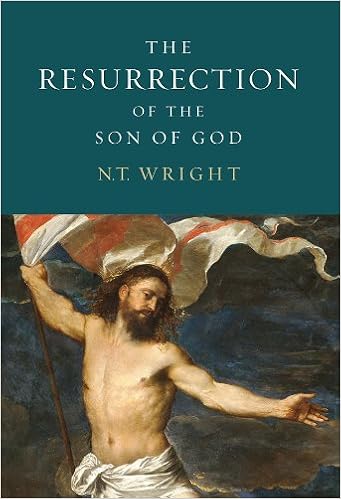
The Resurrection of the Son of God (Christian Origins and the ...

I recently finished New Testament scholar N.T. Wright’s The Resurrection of the Son of God, one of the most thorough surveys of resurrection belief in the Jewish and Christian traditions. This academic 700+ page tome is just a fraction of Wright’s larger project of documenting the origin of Christian belief and the question of its God. It is not for the faint of heart, and for a non-academic like myself, it took a fair amount of endurance to power through some sections. But Wright’s argumentative and writing style is always engaging and thought-provoking, so there certainly was never a boring moment. If there was one topic I wanted to investigate seriously, it was the resurrection of Jesus, which is the most ontologically, politically, and indeed metaphysically revolutionary event in human history. I’ve taken some notes on the book which you can read and comment on here. My notes are not comprehensive or perfectly organized–I’ve listed mostly the key arguments along with points that were particularly salient to me–but they should still give an idea of the thrust of the book.

Starting with a chapter on his historical methodology, Wright then takes deep dives into many ancient texts, analyzing their conceptions of resurrection to elucidate what exactly ‘resurrection’ referred to, and the respective beliefs about it among the relevant cultural and religious groups. This rigorous textual-historical analysis makes up the majority of the book. First come the texts of ancient paganism, then the Old Testament and post-Biblical Judaism, then Paul (with special focus on the Corinthian letters), the non-Easter sections of the rest of the New Testament, non-canonical early Christian texts, and finally the Easter narratives themselves. All throughout are interleaved strong implications for worldview past and present, and footnoted refutations of typical critical-scholarship arguments. Wright finishes with a section on what the historian is obliged to conclude about the cause of the beliefs of the empty tomb and the appearances of the risen Jesus among the early Christians, and the worldview-meaning of the idea of Jesus being the ‘son of God’.

Wright is one of the most popular scholars among thoughtful evangelical and conservative Christians, and for good reason. Even in this academic volume, there is never a hint of ivory-tower obfuscation and blandness; every component of the book is a valuable stop along the long journey of studying the idea of ‘resurrection’. The textual arguments and analysis are brimming with implications for the committed Christian’s beliefs and praxis, even before the priceless section on belief, event, and meaning. One crucial point Wright is at pains to make throughout is how bodily resurrection, of Jesus at present and of God’s people in the future, is utterly central to the worldview of the early Christians (and, implicitly, how it should be for modern ones). It’s not just another point of doctrine we affirm in the creeds, but it is the very paradigm on which the entire Christian faith turns, as Paul himself expounds in 1 Corinthians 15. We must resist the Platonic notion of ‘flying away’ to ‘go to heaven when we die’, and put our eschatological hope instead in the full consummation of the new creation through our own physical resurrection, made possible by the God-Man who is already risen–the same hope of Paul, the evangelists, and the disciples.

I’ll briefly discuss some of the salient points I mentioned earlier. The first is the five different senses of ‘history’. Anyone who’s paid attention to movements like ‘the quest for the historical Jesus’ knows how semantically overloaded this seven-letter word can quickly become. In neatly separating this confusing conglomeration of ‘historical’ ideas, Wright not only begins to expose the gaping flaws in post-Enlightenment historical epistemology, but also articulates a sense of ‘history’ with which laypeople can better understand the biblical ideas of resurrection.

Not being a scholar of any sort myself, I can’t give critique of Wright’s textual analysis, beyond that it is very compelling for the layperson. He provided a few interesting textual arguments that I haven’t previously heard; namely, that Mark once had an authentic fuller ending (lost, and now replaced with the later substitute in 16:9-20), and that John 21 was a later addition to the already-finished gospel by the original author, possibly near or after the end of the evangelist’s life. Many serious Bible-readers know that the Greek word kyrios, Lord, is the same word used for the divine name YHWH in the Septuagint. This multifaceted word, then, conveys that not only is Jesus the long-awaited Jewish Messiah, the Lord of the world over Caesar and all other ‘lords’, but also the God of Israel incarnated. As Wright notes, in their prolific use of the word the New Testament authors demonstrate their thoroughly Jewish and high Christology.

One topic for further investigation that continues to crop up in the tracts of theology and hermeneutics I’ve read is that of biblical ‘inspiration’. The catalyst for this curiosity was Wright’s detailing of how the Septuagint, in certain passages, seems to slightly but meaningfully alter the theology of resurrection present relative to the Masoretic Text and the Dead Sea Scrolls. This then plays into how the New Testament writers (all quoting the Septuagint) and early Christians (mostly Greek-speaking by the second century) understood resurrection. Then the question becomes: in what other notable ways does the Septuagint alter certain points of theology that mattered to the early Christians, and how does this affect our doctrine of biblical inspiration? More broadly, how do we construct a sound theology of inspiration and biblical authority when the authorship, compilation, and self-referencing of the Bible seem ‘messy’ by our ‘modern standards’, as even most conservative biblical scholars are apt to point out? One basic step is, of course, to let the Bible simply be what it is, instead of contorting it into rigid hermeneutical compartments as many evangelicals and ‘literalists’ have done in the name of ‘sola scriptura’, the ‘perspicuity of the text’, and other such nonsense. Part of the beauty of the biblical text is that it is remarkably human in its diversity of style, culture, and theological emphases, and that God saw fit to use this diversity to tell us about himself, his people, and his plan for us in his creation. It would probably be an incomprehensible bore of a book had it just ‘dropped out of the sky’ from God, as many ‘fundamentalists’ more or less claim. All that said, there are many ‘messy’ details to account for, such as canonicity, scribal intent/authority, and authorship of specific books. I hope to investigate this area further, and with any luck I can write about my findings on this blog.

If there is one topic that the layperson should give dedicated, and even academic, attention to, it is surely the resurrection of Jesus Christ. And if there is one book that makes this investigation most thorough, engrossing, and personally contemplative, it is Wright’s own.

Once again, if you want to check out my notes for the book, look here.

The Epistemology of Experience

Recently I’ve had long discussions (and debates) with a good friend of mine, a Millennial, on topics such as religion, sex, morality, and more. This friend, while not an atheist/materialist, would identify as “spiritual but not religious” and has a strong aversion towards organized religion and dogma. In these discussions I noticed a curious way my friend thought about these matters: experience, and experiential knowledge, reigned supreme. For example, my friend claimed I could not judge the moral or practical value of psychedelic drugs, because I had never taken any myself. While I (as a bookish type) might be inclined to research the pharmacology of these drugs or the testimonials of psychonauts, I couldn’t really “know” about these drugs, and thus judge their value, unless I had experienced their accompanying high. 

I’d like to frame my discussion of my friend’s perspective by defining it as an epistemology of experience. Epistemology is, roughly, how we know what we know; here, I am further connoting it as a “knowledge hierarchy” to define which knowledge and sorts of knowledge are most important. In this way, my friend’s personal “knowledge hierarchy” is topped by experiential knowledge. My friend’s life experiences filter and undergird all other knowledge obtained. Here “experience” is used not in the technical, philosophical sense (e.g. regarding “qualia” or similar ideas) but instead in the colloquial “getting out and doing something” or “formative experience” sense. Another example will help. My friend has lived in several different places, visited many different countries and cultures, and experimented with sundry means of reaching a “higher plane of consciousness” (my friend’s words, not mine) through psychoactive drugs and certain Eastern spiritual practices. Because I have done very little of the same, my friend claims a deeper knowledge and authority on these matters, and even on the meaning of life and “consciousness” itself, compared to what I possess. In addition, my friend’s experience of growing up in a particular Christian denomination in a particular culture comprises most of the basis for his general beliefs and assumptions about Christianity and organized religion.

One can see that the epistemology of experience is, in true Western fashion, individualistic through and through. Experiences are subjective by definition, as they concern the individual who is subject to said experiences. This is why the common parlance of the “nones”, those Millennials and “Zoomers” who identify with no organized religion, is so individualized: “finding myself”, “living my truth”, etc. Prima facie communal practices, such as music festivals or spiritual retreats, are primarily (consciously or not) employed to fuel the individual’s “self-actualization” or ascension into a “higher plane of consciousness”, Millennial-ese terms which are undefined and epistemologically meaningless outside of the individual. Who, after all, can know how actualized the self is and should be, other than the self; and who can know and follow the way to a “higher plane of consciousness”, other than the conscious agent who seeks it? The “nones” may salivate over a buffet of ripe and ready teaching, choosing courses from long-standing institutions and traditions of spiritual thought, such as Buddhism, Stoicism, and even Christianity. But while the dutiful “none” may think himself a sufficiently multicultural, others-oriented connoisseur, under his effete epistemology, these comfort-food meals feed individualistic ends.

No doubt merit lies in appraising highly the role of personal experience in our lives. As my friend would rightly argue, you could memorize the Wikipedia page on San Francisco, but you can’t know the city until you’ve felt the Pacific wind in your face, biked up and down hilly streets cramped with old Victorian houses, and enjoyed dumplings from the Tibetan restaurant on the corner. Beyond experiencing a particular person, place, or thing, our personalities and life choices are intimately formed by “life experiences” such as upbringing, moving away from home, having children, and the like. Yet will experience on its own really form a solid base for a practical, lifelong epistemology? Without the requisite experience, how shall I know, for example, that the viper is actually venomous unless I offer my ankle to its dripping fangs? How shall I know that murder is wrong unless I have committed it myself? Either we will make ourselves the subject of every experiential experiment–in which case next year’s Darwin Awards will be very busy–or we must import a priori knowledge into practical situations. Of course, everyone knows the latter is true in practice. Stripped-bare “experiences” will not do. The beginning of wisdom is the fear of the Lord, not the Fear Of Missing Out.

One might raise criticism here at my attempts to debunk a worldview, based primarily on experience, for which I myself have merely experienced through interaction with my friend. But there is research demonstrating the prevalence of the “nones”, and their widespread outlook of “moralistic therapeutic deism” (which emerges out of their personal and cultural experiences). This cohort is diverse, ranging from indifferent agnostics to New Agers to thoroughly Western “Buddhists” to active and engaged spiritual seekers, of which my friend falls in the latter. But all these are united by an atomized, humanistic worldview which could be called “de-problematized”, “cultural”, “consumer”, or “lite” Christianity. At root, though, any good student of history and culture recognizes that they are still thoroughly Christian, as Tom Holland argues in his must-read Dominion

What are some steps that Christians might take in dialogue with this prevalent worldview? A few suggestions materialize. While orthodox Christians like myself put “religion” and “spirituality” in the same conceptual bucket, my friend and “nones” in general make an explicit separation between them. Perhaps, in a difficult but worthwhile exercise, we could challenge the “nones” to rethink their parameters of “religion” and “spirituality”. The former term has accumulated so much cultural baggage that the unpacking is an arduous task, but Holland’s observation is the best place to start: that “religion” is a thoroughly Western, Protestant idea in its common connotation. In addition, there is no doubt we must engage on first principles. For example, we might try to connect “religion” clearly with the much deeper, more ancient human universal to which the term tries to refer, that God has placed eternity in our hearts and created us for community emulating his loving nature. Indeed, in this way, we could help the “nones” recognize that they are just as “religious” as the most ardent churchgoer.

All conversational means aside, if the epistemology of experience is really as entrenched in this generation as it seems, our efforts will be most effective by meeting the “nones” where they’re already at. Take them to a church service of a tradition they’re not familiar with (likely a high-church liturgical service for Americans, but perhaps a low-church evangelical service depending on their upbringing). Invite them to a group Bible study or similar faith-based discussion with other Christians, so the “nones” would not merely learn about Christianity inside their own bubbles, but see how it impacts the lives and experiences of the faithful. Show them examples of Christ’s calling in action through volunteering and engaging with unique ministries dedicated to serving poor inner-city areas, stewarding the environment, healing victims of sex trafficking, and other Kingdom-bringing causes. Let their experience testify to the true, God-given experience that is the Christian life, which is not stodgy, but vibrant; not indifferent, but engaged; not atomized, but communal; not condemning, but loving.  

We can roundly praise the quest of many “nones” for meaning, especially given the current “meaning crisis”. We need only point them towards the Meaning to whom all true experiences must refer, the Logos, and how His incarnated life is the model “experience” that all people were created to fulfill.

Design a site like this with WordPress.com
Get started